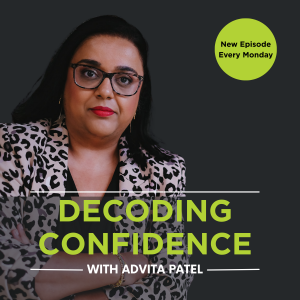
Decoding Confidence
Confidence is talked about constantly, yet rarely explained in a way that feels real, inclusive or sustainable.
Decoding Confidence is a podcast for leaders, professionals and changemakers who want to lead with clarity, courage and authenticity, without pretending to be someone they’re not.
Hosted by confidence and leadership coach Advita Patel, this podcast explores the seven habits of confident leaders and what they look like in everyday working life. Each episode unpacks one habit, offering practical reflections, mindset shifts and grounded insights drawn from coaching, communications and real leadership experience.
This isn’t about charisma or perfection. It’s about building confidence through boldness, empathy, learning, integrity, empowerment, vulnerability and energy, especially when navigating pressure, visibility and responsibility.
The podcast also accompanies Advita’s forthcoming book Decoding Confidence (launching May 2026), giving listeners an early way to explore the ideas, language and practices behind the framework.
Whether you’re leading a team, stepping into greater visibility, or quietly questioning your own confidence, this podcast is here to support you to lead in a way that feels human, sustainable and true to who you are.
New episodes are released every Monday morning.
Find out more at www.decodingconfidence.com.









Episodes
7 days ago
7 days ago
17 min
Your change communications plan has fallen apart. Now what?
You’ve written the narrative, briefed the managers and run the town hall. Then the dates move, leadership changes its mind, and everyone turns to you. According to Gallagher, change communications is the comms skill organisations value most right now. Yet 61% of those same organisations admit they don’t have an approach to change comms. They want us in the room but haven’t given us a map.
In this episode of Decoding Confidence, Advita Patel looks at what happens to our confidence when change goes wobbly. She also covers how internal communications and HR professionals can stay steady, credible and trusted when the plan stops working.
Advita shares five habits from her BELIEVE confidence framework:
Boldness: say it before the rumour mill does. Share what you know, what you don’t know yet and when you’ll come back.
Empathy: listen before you broadcast. Most people aren’t fighting the change; they’re fed up with not knowing what’s going on.
Learning: treat your change comms plan as a living document, not proof of failure when it shifts.
Integrity: don’t dress it up. People aren’t daft, and every gloss over spends trust you’ll need later.
Energy: look after yourself. You can’t be the steady one for everyone if you’re running on fumes.
Timestamps
00:00 When change communications doesn’t go to plan00:47 The Gallagher stat: change comms is the most valued skill, but 61% have no approach01:29 Welcome to Decoding Confidence02:11 Why wobbly change hits our confidence, not just our workload03:38 Habit 1: Boldness, saying it before the rumour mill does04:47 Habit 2: Empathy, listening before you broadcast05:33 Habit 3: Learning, treating the plan as a working document06:35 Habit 4: Integrity, not dressing it up07:49 Habit 5: Energy, and the energy audit09:21 Handling difficult messages: restructures, job losses and pulled projects11:54 How to push back on leaders: bring an alternative, not just a no12:43 Use real employee voices and lead with the why13:28 Ditch the corporate jargon14:05 Get your managers ready first14:36 Involve people in the how, and don’t go quiet afterwards15:41 Treat people like grown-ups: the five habits recap16:13 Key takeaway and the Confidence Quiz
She also covers how to handle difficult messages like restructures, job losses and pulled projects, and how to push back on leaders kindly but clearly.
In this episode you’ll learn:
Why more updates and FAQs rarely fix a struggling change programme
How to tell leaders early when something isn’t working
Three questions to ask when your change plan shifts
Why your job isn’t to make bad news sound good
How to challenge leaders by bringing an alternative, not just a no
Why you should ditch the corporate jargon (“right sizing”, anyone?)
How to prepare line managers before announcements land
Why going quiet after the announcement is where worry creeps back in
Key takeaway: The plan was never what made you good at your job. It’s how you show up when things go a little bit pear-shaped.
Frequently asked questions
What is change communications?Change communications is how an organisation explains, shares and supports people through change, such as restructures, new systems or new ways of working. Done well, it helps people understand what’s changing, why it’s happening and what it means for them.
What should I do when a change communications plan falls apart?Don’t take it as a sign you’re bad at your job. Be open early about what you know, what you don’t know yet and when you’ll update people. Then revisit your plan with three questions: What did we think would happen? What actually happened? What do we now need to do differently?
Why does change affect the confidence of communications professionals?Comms and HR teams are often the face of change. People come to them with their worries, and when things go wrong it’s easy to take it personally. That leads to second-guessing: Should I speak up now? Is it my place? Am I overstepping?
What is the BELIEVE framework?BELIEVE is Advita Patel’s framework of seven confidence habits from her book Decoding Confidence: Boldness, Empathy, Learning, Integrity, Empowerment, Vulnerability and Energy. This episode focuses on the five that help most when change goes sideways.
Should I send more updates when a change programme is struggling?Usually not. More emails, FAQs and reminders can mean people stop listening altogether. Listen first: talk to managers, join team huddles and find out how people are actually feeling.
How do I communicate bad news like restructures or job losses?Be honest and use plain English. Your role isn’t to make bad news sound good. It’s to make sure people know what’s going on, feel involved and understand the why. People can handle change. What they don’t like is being treated as if they can’t handle the truth.
How can I push back when leaders want to make a message sound better than it is?Bring an alternative, not just a no. Show leaders a better version of the message and explain why it works. Use “if we say this, people will hear that” to help them see it through employees’ eyes, and back it up with real comments from across the organisation.
Why should we avoid corporate jargon in change communications?Phrases like “right sizing” or “optimising our footprint” make people feel you’re hiding something. Plain language is more respectful, more inclusive and builds trust.
What role do line managers play in change communications?A huge one. Managers get the questions at the coffee machine and in team briefings, so brief them first. Give them permission to say “I don’t know yet, but I’ll find out” so they don’t feel pressured into making up answers.
What is an energy audit?It’s a simple template Advita uses every 90 days to six months to spot what drains her energy and what fills it back up. Energy is one of the lowest-scoring habits in her Confidence Quiz, and it matters most during long, draining change.
How can I find out which confidence habits come naturally to me?Take Advita’s free Confidence Quiz at decodingconfidence.scoreapp.com. It only takes a few minutes, and you’ll get your results with some practical tips.
Resources mentioned
Take the Confidence Quiz
Energy Audit template
Decoding Confidence by Advita Patel
decodingconfidence.com
Get in touchQuestions, or ideas for future episodes? Email advita@decodingconfidence.com or advita@commsrebel.com, or send Advita a DM on LinkedIn.
If this episode struck a chord, share it with someone in your team or network who is knee-deep in change right now.
Oct 5, 2026
Oct 5, 2026
18 min
Struggling with difficult stakeholders during change? When someone doesn't engage with your change communications, it's easy to assume they're being difficult, or that you're getting it wrong. In this episode of Decoding Confidence, Advita Patel explores another possibility: people aren't difficult, they're different.
Drawing on conversations at the Unite conference, the latest workplace research and the DISC framework, Advita shares practical ways internal communications and HR professionals can influence leaders, build trust and adapt their communication style without changing who they are.
In this episode:
Why we make quick assumptions about stakeholders when we're busy
How Daniel Kahneman's System 1 and System 2 thinking shapes workplace communication
How leading with the "why" transformed Advita's relationship with a director
The 4 DISC communication styles and what each stakeholder needs from you:
D, Dominance: lead with the decision, impact and bottom line
I, Influence: connect through people, energy and vision
S, Steadiness: offer time, reassurance and clarity about what will stay the same
C, Conscientiousness: share evidence, detail and rationale
6 practical tactics for influencing leaders when change moves fast
What to do when a stakeholder still isn't engaging
Why better conversations work better than sending more messages
Memorable quotes:
"People aren't generally difficult, they are just different."
"Saying more isn't the answer, but getting better at the conversation is what is going to work."
"A stakeholder not engaging is rarely a verdict on your ability or your experience."
Try this: Choose one stakeholder you find challenging. Think about their communication style and your own, then change one thing about how you approach them next time. You can also simply ask: "What's the best way to keep you updated on this?"
Resources and links:
Decoding Confidence Book by Advita Patel
Take the Confidence Quiz: decodingconfidence.scoreapp.com
Explore your DISC profile with Advita
Connect with Advita on LinkedIn
CIPD Good Work Index 2026
Gallup State of the Global Workplace 2026
Gartner change adoption research, October 2025
Gallagher 2026 Employee Communications Report
Thinking, Fast and Slow by Daniel Kahneman
Sep 28, 2026
Sep 28, 2026
48 min
What does leadership confidence really look like when you're having a rough week? In this episode of Decoding Confidence, I'm joined by my good friend Bridget Aherne, a senior public-sector communications leader, a Chartered PR Practitioner, and one of the most honest people I know.
We met properly during those six-feet-apart walks in the park during COVID, and this conversation has the same feel. Bridget talks openly about the gap between how confident she looked and how confident she felt, and what she does when she doesn't show up as the leader she wants to be.
Table of contents
About this episode
Meet Bridget Aherne
What we cover
Bridget's three lessons for leadership confidence
Standout moments
Timestamps
FAQs
Resources and links
About this episode on leadership confidence
Bridget describes herself as having that Irish Mancunian swagger from a young age. Boldness came naturally. Self-belief underneath it didn't always follow.
As the daughter of an Irish immigrant father whose advice was to work hard and not get found out, she grew up without role models who'd been to university. Her route into journalism, radio and eventually PR was hard won. Mine was too, and we talk about what it means to build a career without the connections others take for granted.
This is a conversation about confidence as something that moves with you through life, rather than a fixed trait you either have or don't.
Meet Bridget Aherne
Bridget is a communications leader in local government in Greater Manchester, with a career spanning newspaper journalism, radio, Greater Manchester Fire and Rescue, Metrolink and her own consultancy. She became a Chartered PR Practitioner in 2018 and has been a huge part of the comms community in the North West for years.
She's also the person who named the CommsHive, which I'll forever credit her for.
What we cover
Why outward boldness doesn't always mean inner self-confidence
Growing up with immigrant parents and the pressure to keep your head down
Becoming CIPR chartered, and whether it changed how Bridget saw herself
Why admitting a lack of confidence can feel career-limiting for senior leaders
What to do when you get it wrong with your team, and how to rebuild psychological safety
How knowing your strengths helps you take control of your own narrative
The myth that confidence has to be loud
Why your personal story belongs on your CV
Bridget's three lessons for leadership confidence
When I asked Bridget what advice she'd give a leader who's struggling, she gave three clear lessons.
1. It's okay not to be confident all the time
Nobody starts a new role feeling confident. Leadership confidence isn't linear. Life changes, hormones, a close colleague leaving, organisational pressure: all of it affects how we show up at work.
2. Keep moving forward
That might mean a new job. It might mean getting over a moment where you didn't live up to your own values. Bridget loves that the BELIEVE framework talks about habits, because habits can be developed. They aren't fixed character traits.
3. Find your network
Networks got Bridget through a lonely time in a difficult job. Her advice is to pick someone you admire and send them a message. The worst that happens is they don't reply.
Standout moments
Apologise quickly and move on. Bridget shares, with real vulnerability, a moment when she spoke to a team member in a way she wasn't proud of during a tough restructure. Drawing on her crisis comms background, she owned it, apologised quickly and focused on resetting psychological safety. We also talk about why "I'm sorry you felt that way" is not an apology.
Confidence is more than the sum of our parts. For Bridget, confidence isn't an individual thing. It's about creating spaces where everyone can bring their strengths, try things and fail fast. Her CliftonStrengths top theme, individualisation, sits at the heart of how she leads.
Quiet confidence counts. When Bridget moved into rail, she was quieter in meetings than people expected. The feedback? People waited for what she had to say because she'd listened first. Strong leadership confidence doesn't need to be the loudest voice in the room.
Your story matters. Bridget once removed Irish dancing and music from her CV, even though they were what caught an editor's attention. I did the same with years of working in my parents' shop. Neither of us would hide those experiences now.
Timestamps
00:00 - Bridget’s credibility and career across public service, comms, and transformation01:29 - Why this podcast exists and the question of early-career confidence01:45 - Bold on the outside, uncertain on the inside03:08 - Journalism ambitions, missed connections, and finding her way through radio04:07 - What it felt like to finally “make it” in a newspaper role05:46 - Why chartership matters in PR and communications06:59 - The motivation behind pursuing chartership08:45 - Professor Anne Gregory and the profession’s standards09:15 - Passing chartership in front of Amanda Coleman10:10 - Chartership, ethics, leadership, and credibility in practice12:00 - Why seeing trusted peers succeed gave Advita the push to do it too14:20 - Why confidence can feel shameful for senior leaders15:41 - Confidence is not linear and it is okay not to be okay17:31 - Stress, HRT, restructures, and how real life affects leadership18:57 - Three confidence habits: accept the wobble, keep moving, build your network19:26 - Finding community through sector networks and online outreach21:27 - Why leaders should acknowledge when they have damaged psychological safety23:57 - Apologise quickly, own it, and reset the relationship28:38 - Confidence as collective strength, not an individual performance29:34 - Seeing systems and people through strengths-based leadership31:02 - “Bridget sees strangers as friends she just hasn’t met yet”34:27 - Debunking the myth that confidence is loud, certain, and first out of the blocks35:25 - Being quiet in meetings and still adding value through timing and listening39:19 - Why different event formats and smaller spaces help different communicators thrive41:36 - Advice to young Bridget: find connections sooner and stop waiting for permission43:27 - Don’t put careers or authority figures on pedestals46:40 - Why personal stories and lived experience belong on your CV and in your confidence47:22 - A final reflection on childhood work experience and owning every part of your story
FAQs
What is leadership confidence?
Leadership confidence is the self-belief to make decisions, speak up and support others, while staying open to learning. It isn't about certainty or volume. As Bridget shows, it includes owning your mistakes.
Is confidence linear?
No. Confidence rises and falls with life events, workplace changes and health. Treating it as a set of habits you can practise, rather than a fixed trait, makes the dips easier to recover from.
How should a leader apologise to their team?
Quickly and without excuses. Explain the context if it helps understanding, but don't use it to dismiss what happened. Then focus on rebuilding psychological safety so people feel supported.
Is CIPR chartership worth it?
For Bridget, it strengthened her credibility and crystallised how she articulates communications as a strategic leadership function. It also gave her personal pride. Whether it's right for you depends on your goals.
Resources and links
My book, Decoding Confidence: The Seven Habits of Confident Leaders, is out now
Take the Confidence Quiz: decodingconfidence.scoreapp.com
Find out about the CommsHive
Learn more about becoming a Chartered PR Practitioner with the CIPR
Explore CliftonStrengths
Connect with Bridget Aherne on LinkedIn
Listen to why psychological safety is important in the workplace
Sep 21, 2026
Sep 21, 2026
50 min
Season two of Decoding Confidence opens with a role reversal. Kaz Hassan, who leads Partner Marketing and Thought Leadership at Unily and has interviewed everyone from Tan France to Mo Gawdat, usually holds the microphone. This time Advita Patel turns the tables and interviews him about what confidence really means.
It's a candid, practical conversation. Kaz reframes confidence as self-trust rather than volume or extroversion, and explains why some of the loudest people in the room are often the least sure of themselves. He shares how he prepares for high-pressure interviews in front of hundreds of people, why he watches himself back even when colleagues find it odd, and how "remembering we're all just people" quietly dissolves the fear of big names and big rooms.
The two also get honest about the personal feedback that chips away at confidence, from comments on dress sense to being told you're "too expressive." They talk about unlearning people-pleasing, protecting your self-esteem online, and building a trusted learning circle so you take advice from the right voices and tune out the rest.
If you want to speak with more confidence, build trust faster and show up as yourself at work, this one's for you.
What you'll learn
Why confidence is really self-trust, and how to spot it in yourself and others
How Kaz prepares for and then improvises through interviews with high-profile guests
Why watching yourself back is one of the fastest ways to improve as a speaker
How to build trust quickly with audiences, stakeholders and clients
Why working on your own confidence has to come before any "trust tactics"
How to handle personal, unhelpful feedback without letting it dent your self-worth
How to build a learning circle, or personal board of directors, of believers, mirrors and connectors
Timestamps
00:00 Pre-chat and getting set up01:28 Welcome to season two and flipping the interviewer role02:28 What confidence really means04:09 Big names, big rooms, and why they still feel human05:23 Natural curiosity versus learned confidence06:58 Why remembering "we're all just people" changes everything10:02 The pressure of interviewing live in front of huge audiences11:55 How Kaz prepares, then improvises in the moment13:49 Why watching your own work matters15:33 Prep, practice and improving by reviewing your talks18:42 Why LinkedIn visibility makes some people uncomfortable22:14 Being visible at Unily without wanting the pedestal27:14 How to build trust quickly with audiences and stakeholders28:13 Why self-confidence comes before trust tactics30:26 Don't overcomplicate trust33:17 Unlearning people-pleasing and the need to be liked34:44 Bad advice about authenticity and dress code38:09 Personal feedback that can damage confidence41:12 Why a trusted learning circle beats random advice44:34 What Kaz would tell his younger self before the Tan France interview46:52 Entering flow through presence and perception48:38 Final recommendation: learn from many styles, not one formula53:02 Closing reflections and thanks
Notable quotes
"Confidence is with trust." Kaz Hassan
"Some of the loudest characters I know are the least confident in themselves." Advita Patel
"We're all just people." Kaz Hassan
"If you're everyone's cup of tea, you'd be a mug." Kaz Hassan
"Adding polish on top of the wrong foundation." Kaz Hassan, on chasing trust tactics before building self-confidence
FAQ
What is confidence, really?In this episode, confidence is defined as self-trust. It's whether you back yourself, stand by your convictions and trust your ability no matter what life throws at you. It is not about being loud, bold or extroverted. In fact, some of the loudest people in a room are the least confident, using volume as a mask.
How do you build trust quickly with an audience or stakeholders?Kaz shares two core tips. First, work on your own self-confidence before reaching for any trust techniques, because polish on a shaky foundation falls flat. Second, treat every person as an individual rather than running them through a formula. Trust is built through honesty, respect, and genuinely understanding the person in front of you.
How do you prepare for a high-pressure interview or presentation?Do the research first: watch their talks, read their books, understand their tone and expertise. Then let go of the script enough to stay present. Kaz listens for the unexpected thread in an answer and takes a beat before asking his next question, so he responds to what was actually said rather than rushing to the next item on a list.
What is a learning circle, or personal board of directors?It's a small, intentional group of trusted people whose feedback you genuinely value. Advita describes three types: believers who champion you, mirrors who reflect you honestly, and connectors who build bridges for you. The point is to take advice from voices who know you and your work, and to tune out unsolicited feedback from everyone else.
How should you handle unhelpful personal feedback?Disregard vague or judgmental personal feedback, especially in performance reviews, when it lacks evidence of impact on your work. Comments on dress sense, speaking too fast or being "too expressive" can damage self-esteem without helping you grow. Good feedback is specific, evidenced and focused on helping you improve.
Does watching yourself back really help you improve?Yes. Both Advita and Kaz record and review their own talks. Advita watched herself back around 100 times when she started speaking in 2019, until she felt comfortable with her voice and delivery. Reviewing your own work, without beating yourself up, is one of the fastest ways to get better.
Resources and links mentioned
Kaz Hassan on YouTube: https://www.youtube.com/@kazhassan
Kaz Hassan on LinkedIn: https://www.linkedin.com/in/kazhassan/
Unily: https://www.unily.com/
Unite (29-30 September): https://www.unily.com/unite?utm_campaign=24500077-Futures&utm_source=advitabooklaunch (use the code BELIEVE to get a 25% discount)
Decoding Confidence, Advita's book: https://decodingconfidence.com/book/
Previous Decoding Confidence episode on the learning circle: https://decodingconfidence.com/podcast/episode-3-leading-with-empathy-how-confident-leaders-build-trust/
Vanessa Van Edwards on body language, Science of People: https://www.scienceofpeople.com/vanessa-van-edwards/
A Drag Queen's Guide to Life by Bimini Bon-Boulash (also on audiobook): https://www.penguin.co.uk/authors/287507/bimini-bon-boulash
And yes, the strangely calming lawn-mowing YouTube channel Advita loves: https://www.youtube.com/@sbmowing
Jul 6, 2026
Jul 6, 2026
14 min
In this episode, Advita Patel explores the concept of the confidence stack, a framework that helps individuals and organisations understand how confidence operates across different layers.
She emphasises that confidence is not solely an individual trait but is deeply interconnected with organisational culture and team dynamics.
Main topics:
The three tiers of the confidence stack: inner self, shared culture, organisational environment
Why individual confidence alone isn't enough to foster real psychological safety
The importance of trust, belonging, and systemic support in building confidence
How organisational policies can be performative without genuine cultural change
Practical habits to support confidence development at each tier: boldness, vulnerability, empathy, integrity, learning, energy, and empowerment
The sequential nature of the confidence stack and why self-awareness is foundational
Recognising signals and signs to adapt and build confidence intentionally
Timestamps:
0:00 — Opening question about preparing for a meeting and freezing under pressure
0:27 — Confidence coaching, confidence as a skill
0:54 — What happens when the organization doesn’t help create safety
1:20 — Intro to the episode: what confidence looks like at work
2:03 — Introduction to the confidence stack
2:23 — Training, workshops, and personality assessments
3:03 — Why inner work alone isn’t enough
3:29 — Workplace disengagement and not feeling safe to speak up
4:20 — Why environment matters for confidence
4:47 — Tier 1: inner confidence and self-belief
5:16 — Tier 2: shared confidence, trust, and belonging
5:42 — Speaking up against power and building safe culture
6:08 — Tier 3: organizational culture and systems
6:36 — Why policies can be performative without accountability
7:01 — What this means in real life
7:17 — Belief habits vs traits
7:41 — Confidence isn’t fixed; it must be adapted
8:21 — Boldness and vulnerability at the inner tier
9:11 — Checking when and why you hold back in meetings
9:37 — Empathy and integrity at the shared tier
10:26 — Organizational systems and bias
11:23 — Recap: confidence isn’t just individual responsibility
11:51 — Inner work is important, but not everything
12:06 — Toxic culture and deciding whether a team helps you succeed
13:08 — Confidence takes time, habits, and energy
13:37 — Final recap and call for listener thoughts
14:02 — Mention of previous episodes and the book
14:27 — Outro and ask to share/review
More information
Decoding Confidence: The Seven Habits of Confident Leaders
Advita Patel's Website
Follow Advita on LinkedIn
How we can support you
Coaching with Advita
Radical Candour Study
Jun 29, 2026
Jun 29, 2026
19 min
This episode dives into the growing issue of workplace languishing, in which over 60% of workers feel disengaged and disconnected. Advita Patel explores the core role confidence and leadership behaviours play in fostering a psychologically safe environment that boosts engagement, innovation, and retention.
In this episode:
The alarming statistics on workplace disengagement from the 2026 Workplace Wellbeing Report
The concept of languishing: what it is and how it manifests silently in teams
Why the “listening to action gap” damages trust and engagement
The importance of psychological safety and its link to productivity and innovation
How confidence is a collective cultural issue, not just individual bravado
Practical prompts for leaders to build more psychologically safe work environments
The influence of leadership behaviours on team confidence and engagement
Tips to recognise and address uneven psychological safety within teams
Timestamps:
00:00 - The surprising statistic on worker languishing and its global impact00:25 - The differences in engagement levels between US and UK workers00:51 - The decline in global employee engagement and its economic toll01:20 - Why leadership is at the heart of workplace disengagement02:09 - Introduction to the episode and what confidence truly looks like at work02:26 - The core problem of workplace languishing and misconceptions about wellness fixes03:11 - Defining languishing: what it looks like inside and outside the workplace03:36 - How languishing can be invisible and what behaviours signal it04:04 - Examples of disengaged behaviours in meetings and teamwork04:28 - The reality that most of the workforce is affected and why simple perks won’t fix it04:52 - The “listening to action gap” and its role in eroding trust05:02 - Why employees feel unheard and the importance of closing the feedback loop05:59 - The critical role of psychological safety in employee engagement06:18 - Concrete examples of psychological safety and its impact on performance07:12 - The business case for emotional safety, especially for underrepresented groups08:04 - Clarifying what psychological safety isn’t: no conflict, no challenge08:57 - How psychological safety boosts innovation and prevents crises09:25 - Connection between confidence, safety, and organisational culture10:00 - Leaders’ influence in creating environments where people can speak up10:29 - The value of honest conversations and healthy disagreement11:09 - Confidence as a culture, not just an individual trait11:18 - The signals leaders send daily and their impact on confidence12:22 - Four prompts for leaders to foster psychological safety this week:
Where are you making it safe not to know?
What is your feedback-to-action ratio?
Who in your team feels psychologically safe?
How are your behaviours shaping the environment?
13:16 - The importance of openly admitting uncertainty and fostering collaboration13:52 - The need to close the feedback loop and visibly act on input14:34 - Recognising inequities in psychological safety among diverse groups15:48 - The influence of managers on employee engagement and confidence16:16 - Demonstrating vulnerability and self-awareness as leadership tools16:52 - Checking power dynamics and how decisions influence confidence levels17:19 - The global nature of the workplace wellbeing crisis17:46 - How confidence is rooted in trust and behavioural consistency18:07 - Small actions that can start reversing disengagement and eroding safety18:58 - How leadership creates conditions for confidence to thrive, not just training or policies19:04 - Tips for reflecting on your team’s confidence and safety environment
Resources & Links:
Decoding Confidence - Book by Advita Patel
University of Illinois 2026 Workplace Wellbeing Report
Gallup State of the Global Workplace Report
Want to understand more about which confident habit you should focus on first? Take the free assessment, and the results will be sent to you immediately.
Jun 22, 2026
Jun 22, 2026
37 min
What does real confidence look like for young women in leadership? In this episode, PR strategist and founder Parul Yadav gets candid about building self-trust, challenging cultural expectations, and leading authentically without shrinking or performing.
Parul is the founder of North Wave Media, a PR and integrated communications agency operating across Canada and the U.S. Her journey, from navigating first-generation family pressures to running a cross-border agency, is a masterclass in quiet confidence and intentional leadership.
If you're an entrepreneur battling imposter syndrome, self-doubt, or the pressure to lead a certain way, this conversation is for you.
What You'll Learn
Why confidence matters more than competence and how to close the gap
How cultural narratives and family expectations shape self-doubt for South Asian women
What quiet confidence actually looks like in leadership (and why extroversion is overrated)
How to stop waiting for permission and start taking action
Practical strategies for overcoming fear of failure and perfectionism
How to advocate for yourself and build authentic visibility in the workplace
Why unlearning Western leadership models unlocks your real leadership style
Episode Timestamps
(00:00) - Introduction to Parul Yadav and her journey in PR
(02:00) - Confidence vs. competence: what's the real difference?
(03:32) - Visible vulnerability and why exposure builds confidence
(05:38) - The moment confidence became central to her path
(06:11) - Small decisions that shifted her self-perception
(08:35) - Cultural expectations and being a first-generation South Asian woman
(09:54) - Talking career choices with family in traditional communities
(11:43) - Letting go of external validation as an entrepreneur
(13:21) - How cultural narratives fuel self-doubt and fear
(15:30) - Overcoming perfectionism and fear of failure
(17:49) - Intentional presence and what authentic visibility really means
(20:17) - Quiet confidence vs. performative confidence
(21:39) - Debunking the myth that confident leaders are extroverts
(27:27) - Unlearning Western confidence ideals and leading on your own terms
(32:20) - Why action beats waiting until you feel ready
(34:18) - Small acts of bravery that build real momentum
(35:54) - Embracing your authentic story as a leadership strength
(36:27) - Where to find Parul + her final advice for listeners
Resources & Links
North Wave Media
Parul Yadav on LinkedIn
CommsRebel
Decoding Confidence: The 7 Habits of Confident Leaders.
Want to understand more about which confident habit you should focus on first? Take the free assessment, and the results will be sent to you immediately.
Keywords: confident leadership, women of colour in leadership, BIPOC entrepreneurship, South Asian women in business, imposter syndrome, quiet confidence, authentic leadership, building self-trust, overcoming fear of failure, first-generation professionals, PR and communications, women in entrepreneurship
Jun 15, 2026
Jun 15, 2026
31 min
How do you stay confident at work when your workload is unmanageable, your manager is draining your energy, or the people around you are quietly negative?
In this listener Q&A episode of Decoding Confidence, confidence and influence coach Advita Patel answers real questions about building confidence at work and handling the everyday situations that knock it.
From pushing back on an overwhelming workload without feeling like you are failing, to protecting your energy around a difficult boss, setting boundaries with negative colleagues and staying motivated through job search rejection, this episode is full of practical, doable advice for feeling surer of yourself at work.
In this episode
How to push back on an overwhelming workload without feeling like you are not up to the job.
Simple ways to manage and protect your energy when you are dealing with a difficult manager.
Building the confidence to go after opportunities, rather than second-guessing yourself out of them.
Handling sarcasm and negativity from colleagues, and setting boundaries that actually hold.
Staying motivated through job search rejection, and using structured reflection to keep your confidence intact.
Getting through to an unresponsive or dismissive boss, and improving the way you communicate upwards.
Knowing when the respect just is not there, and how to plan your exit on your own terms.
Timestamps
00:00 - Introduction: decoding confidence at work
00:27 - How to push back on workload pressure
01:23 - Prioritising tasks and communicating with leadership
02:43 - Celebrating weekly wins to reinforce your self-worth
05:53 - Managing the energy drain caused by leadership behaviour
06:51 - Adjusting your communication style to protect your energy
12:32 - Overcoming self-doubt and advocating for yourself
14:54 - Reframing past achievements to build self-confidence
17:44 - How to let sarcasm and negativity slide off you at work
20:18 - Why a strong learning circle and support network matters
22:01 - Staying motivated through job rejection and hiring automation
27:01 - Handling unresponsive managers and planning your next move
Resources and links
Decoding Confidence: The Seven Habits of Confident Leaders, book by Advita Patel
Brené Brown, The Power of Vulnerability: https://brenebrown.com/
DISC behavioural framework
Vicky Marinka, career community for communications professionals
Connect with Advita Patel
LinkedIn: https://linkedin.com/in/advitapatel
Instagram: https://instagram.com/advitap
TikTok: https://tiktok.com/@CommsRebel
More support
For more on building confidence at work, head to https://decodingconfidence.com for blogs and insights, and follow Advita for regular, practical tips on backing yourself at work.
Tags: confidence at work, building confidence, difficult boss, setting boundaries at work, job search rejection, self-doubt, career confidence, communicating with your manager, workplace wellbeing, professional development
Jun 8, 2026
Jun 8, 2026
14 min
Why are you confident in one workplace and strangely quiet in the next?
In this episode of Decoding Confidence, Advita Patel explores how workplace culture shapes our confidence far more than we tend to admit, and why confidence is rarely just a personal trait you either have or lack.
Drawing on a Harvard Business Review framework that maps eight different types of company culture, Advita walks through how confidence shows up so differently in caring, purpose-driven, results-oriented and authority-led environments, and what that means for inclusive leadership, psychological safety and the way we talk about confidence at work.
If you have ever been told you simply need to be more confident, this episode reframes the whole conversation.
In this episode
How workplace culture shapes confidence, and why your environment can either grow your self-belief or quietly chip away at it.
The eight types of company culture, mapped on how an organisation handles change and how its people relate to one another.
The shadow side of warm, caring and purpose-driven cultures, where a need for harmony can quietly silence healthy disagreement.
Why fast-paced, high-energy cultures can leave more reflective and considered people looking far less confident than they actually are.
How results and authority cultures so often mistake volume and certainty for genuine confidence.
Why speaking truth to power is hardest in authority-led cultures, and how to do it as a trusted advisor rather than someone begging to be heard.
How structured, process-driven cultures reward preparation but can quietly penalise the person who thinks out loud.
What it means for leaders to broaden their definition of confidence, so more than one way of showing up gets to count.
Practical steps if your culture does not fit how you work, from adapting, to finding the pockets where you can be yourself, to knowing when it is time to move on.
Timestamps
00:00 - How your environment shapes your confidence
00:26 - Why workplace culture matters more than we admit
01:09 - The eight types of company culture explained
02:12 - How confidence behaves differently across cultures
03:45 - The warm cultures: caring and purpose-driven workplaces
04:37 - The shadow side: when harmony silences disagreement
05:23 - The open cultures: confidence as energy and experimentation
06:43 - Results and authority cultures: volume mistaken for confidence
07:58 - Why speaking truth to power is hardest here
09:10 - The structured cultures: confidence built on preparation
10:12 - Matching your culture to how you actually work
11:01 - Empowerment and broadening what confidence looks like
12:04 - Knowing when a culture limits you, and what to do about it
12:54 - Building cultures where more than one style can thrive
13:22 - Resources and further reading
14:12 - A reflection for leaders
Resources and links
Decoding Confidence: The Seven Habits of Confident Leaders, book by Advita Patel
Building a Culture of Inclusivity, co-authored by Priya Bates and Advita Patel
The 8 Styles of Company Culture, Harvard Business Review: https://hbr.org/data-visuals/2020/01/the-8-styles-of-company-culture
Sarah Black on cultural intelligence
How DISC can help you thrive episode
Email Advita: advita@decodingconfidence.com
Connect with Advita Patel
LinkedIn: https://linkedin.com/in/advitapatel
Final thoughts
Understanding how your environment shapes your confidence changes everything, both for your own growth and for the way you lead. No single culture is right or wrong, but each one makes confidence easy for some people and quietly hard for others.
Once you can see that, you can either adapt, find the spaces where you do your best work, or build something better. And when leaders make room for more than one style of confidence and contribution, they end up with stronger, braver and more creative teams.
If you want support in your organisation, either with internal communications, culture or confidence, get in touch: hello@commsrebel.com.
Tags: workplace culture, confidence at work, company culture types, psychological safety, inclusive leadership, speaking up at work, internal communications, leadership development, self-belief, organisational culture
May 25, 2026
May 25, 2026
18 min
Building Confident Cultures: Unlocking Organisational Success
What does it really take to build a workplace culture where people thrive, perform, and stay?
In this episode, communications and inclusive culture consultant Advita Patel explores what it means to create a confident organisational culture, one built on psychological safety, authentic leadership, and genuine belonging. From the financial cost of disengaged workplaces (over £23 billion lost annually in the UK alone) to the everyday behaviours that quietly erode or build trust, Advita breaks down what leaders, HR professionals, and communicators need to know.
Whether you're navigating toxic leadership dynamics, trying to improve employee engagement, or looking to build a more inclusive culture from the inside out, this episode gives you practical, research-backed steps you can act on at every level of your organisation.
Advita covers the warning signs of performative inclusion, the dangers of the hippo effect, and why confident cultures are built through small, deliberate acts rather than sweeping strategy. If you care about retention, psychological safety, and creating workplaces where every person feels they belong, this one's for you.
Key Topics:
The financial impact of poor company culture: over £23 billion lost annually in the UK alone
What a confident culture looks like: psychological safety, authenticity, and vulnerability
The benefits of confidence in organisations: increased retention, better decision-making, and higher belonging
Recognising toxic behaviours: the hippo effect, performative inclusion, and silence as a weapon
Practical actions for individuals and leaders to foster a confident culture
The importance of small, deliberate acts over a one-size-fits-all strategy
Research Highlights:
Boston Consulting Group: Employees who can be their authentic selves at work are nearly 2.4 times less likely to quit. BCG
Boston Consulting Group – Psychological Safety Levels the Playing Field: When psychological safety is high, only 3% of employees are at risk of quitting, compared to 12% when it is low. BCG
Google's Project Aristotle: Psychological safety is the most important factor for high-performing teams, which outperform peers on every key metric. Amazing Workplaces
BetterUp: Employees who feel a strong sense of belonging experience a 56% increase in job performance, a 50% reduction in turnover risk, and a 75% decrease in sick days. Business Wire
Timestamps:
00:00 - The economic cost of disengaged workplaces and the business importance of culture00:27 - Introduction to confident organisational cultures and their impact01:01 - Defining the core elements of a confident culture02:10 - Key indicators of a confident environment: safety, inclusion, transparency03:00 - How leadership models vulnerability and authenticity influence culture04:48 - Positive outcomes of confident cultures: retention, decision quality, belonging05:45 - Research backing the importance of psychological safety and belonging06:38 - The detrimental effects of toxic behaviours and leadership flaws08:03 - Red flags that threaten organisational confidence: the hippo effect, performative diversity09:24 - The dangers of one-way feedback and silence when issues arise10:15 - Addressing toxic leadership and its impact on team confidence11:12 - Recognising and challenging toxic patterns, normalising positive behaviour12:08 - Practical ways for individuals at all levels to influence culture12:58 - The power of language, crediting ideas, and documenting experiences13:25 - Managing micro-cultures and modelling behaviours as a people leader14:21 - HR and communications' role in shaping authentic culture15:07 - Culture building through everyday deliberate acts and habits16:03 - Small acts that contribute to a confident culture; the importance of integrity16:28 - Reflecting on personal influence: green flags and red flags in your workplace17:24 - Sharing this message and engaging with Advita on LinkedIn for ongoing change17:41 - Promoting Advita’s book, Decoding Confidence, and inviting guest suggestions18:27 - Closing remarks and encouragement to lead cultural change
Resources and links:
For a limited signed edition, you can purchase my brand new book directly from Decoding Confidence – The 7 Habits of Confident Leaders
To recommend a guest or if you want to appear as a future guest, email advita@decodingconfidence.com
At CommsRebel we build confident workplaces through effective internal communications so everyone can be their best selves. To find out how we can support you visit www.commsrebel.com.