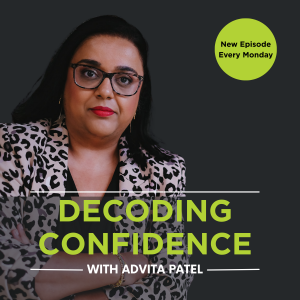
Decoding Confidence
Confidence is talked about constantly, yet rarely explained in a way that feels real, inclusive or sustainable.
Decoding Confidence is a podcast for leaders, professionals and changemakers who want to lead with clarity, courage and authenticity, without pretending to be someone they’re not.
Hosted by confidence and leadership coach Advita Patel, this podcast explores the seven habits of confident leaders and what they look like in everyday working life. Each episode unpacks one habit, offering practical reflections, mindset shifts and grounded insights drawn from coaching, communications and real leadership experience.
This isn’t about charisma or perfection. It’s about building confidence through boldness, empathy, learning, integrity, empowerment, vulnerability and energy, especially when navigating pressure, visibility and responsibility.
The podcast also accompanies Advita’s forthcoming book Decoding Confidence (launching May 2026), giving listeners an early way to explore the ideas, language and practices behind the framework.
Whether you’re leading a team, stepping into greater visibility, or quietly questioning your own confidence, this podcast is here to support you to lead in a way that feels human, sustainable and true to who you are.
New episodes are released every Monday morning.
Find out more at www.decodingconfidence.com.









Episodes
Apr 20, 2026
Apr 20, 2026
41 min
What if the key to greater confidence, less stress, and better decision-making was already inside you? In this episode, Advita speaks with Dr Jackie Le Fèvre, founder of Magma Effect, about how understanding your personal values can transform how you lead, work, and live.
From her unexpected journey from zoology to human behaviour, Jackie brings a fascinating, science-backed perspective on why values matter and what happens when we ignore them.
Whether you're a leader trying to build a more authentic culture, an HR professional supporting your people, or simply someone who wants to feel more grounded in your choices this one's for you.
What we cover:
How Jackie went from wildlife conservation to human values and behaviour
The surprising biological link between humans and chimpanzees
Why surfacing your core values boosts confidence and sharpens decision-making
The science behind values, cortisol, and stress resilience
How to handle the tension between personal and organisational values
Practical tools and reflective questions to identify what truly matters to you
How to have brave conversations when your values don't align with your organisation's
The gap between declared values and lived values — and what to do about it
Timestamps:
00:00 — Introduction
02:02 — Jackie's journey from zoology to human behaviour
03:00 — The biological link between humans and chimpanzees
07:10 — How values shape confidence and decision-making
08:09 — The benefits of naming and articulating your core values
15:30 — Values, stress, and cortisol regulation
22:05 — Managing personal vs. organisational values conflicts
25:28 — Values and leadership culture
35:59 — Reflective questions to uncover what matters most
41:04 — Closing the gap between declared and lived values
44:13 — How to raise values misalignment with leaders
45:02 — Closing thoughts
Resources mentioned:
Magma Effect
Values Exercise Tool
Decoding Confidence by Advita Patel - Pre-order now available
Jackie on LinkedIn
More about Jackie's work:
Jackie Le Fèvre FCMI is the founder of Magma Effect and was awarded her doctorate for exploring the link between conscious connection to value and well-being by the University of Hertfordshire in November 2023. Originally qualified as a zoologist and after more than a decade in nature conservation Jackie turned her attention to human behaviour and has been trying (often unsuccessfully) to understand people ever since.
Following a career in the voluntary and community sector working at local, regional and national level Jackie began to specialise in consciously values-based practice in 2004. Jackie is National Advisor on Values to Wellbeing Teams which in 2018 won three national awards for values-based recruitment including the Guardian Public Service Award for HR. As a member of the Subject Matter Experts Group of the Chartered Institute of Management Jackie holds a remit for values and culture. Jackie is also a member of the UK Values Alliance and is a founder member of the Global Values Alliance.
In the last 7 years Jackie has developed a storytelling methodology for surfacing values from lived experience. To date 30 values and storytelling projects have been undertaken with organisations ranging from Chailey Heritage Foundation and Neighbourhood Midwives to the Health and Safety Executive, English Sport, Which? and the University of Manchester. Between 2020 and 2022 Jackie worked with NHS organisations in the South West on the values present in patient and family stories of end of life and palliative care https://www.careopinion.org.uk/blogposts/1030/values-inside-stories.
Apr 13, 2026
Apr 13, 2026
23 min
Are you or your team members staying silent in meetings, even when you have something important to say? In this episode of Decoding Confidence, Advita Patel breaks down what workplace confidence actually looks like, why "fake it till you make it" falls short, and what leaders and employees can do to build a genuine speak-up culture.
Whether you're a leader trying to improve psychological safety on your team, or an individual navigating the fear of speaking up at work, this episode gives you practical, actionable strategies you can use immediately.
What you'll learn:
Why organizational silence is a leadership problem; not just an individual one
The hidden costs of a culture where employees don't feel safe to speak up (think: poor decisions, disengagement, and talent loss)
Leadership behaviours that build or destroy psychological safety
How to spot the signs your team is silencing themselves
Practical tools including anonymous feedback channels, seeking dissent, and modelling vulnerability
How to manage the fear of speaking up and build confidence through low-stakes practice
Why cultural awareness matters and who's actually speaking in your meetings
Episode Timestamps
00:00 – What workplace confidence really looks like beyond fake bravado
00:27 – The real cost of staying silent in meetings and organisations
01:08 – Why fear of speaking up is a cultural problem, not a personal one
01:32 – Leadership's role in creating space for honest, challenging conversations
02:25 – The gap between leaders feeling open and employees feeling safe
02:52 – How silence leads to incomplete information and bad decision-making
03:44 – Subtle behaviours that quietly erode psychological safety
04:32 – How to spot when your team isn't comfortable speaking up
06:07 – The internal experience of fearing retaliation and social consequences
07:03 – How your brain's threat detection system shuts down communication
07:31 – The slow erosion of confidence through workplace micro-signals
08:44 – Why confidence is contextual and relational — not a fixed trait
09:11 – The importance of listening to the quietest people in the room
10:12 – How silence becomes self-reinforcing and blocks innovation
11:02 – The impact of a silent culture on new hires and existing teams
11:28 – Fatigue and demoralization from feeling unheard at work
12:00 – Signs you might be creating an environment where feedback is withheld
12:42 – The danger of unchallenged decisions and rising disengagement
13:09 – Are you creating real space for feedback, or just paying lip service?
13:30 – Culture isn't what you say — it's what you do when things get hard
14:22 – Practical actions: seeking dissent and building anonymous feedback channels
15:41 – Why closing the feedback loop is non-negotiable for trust
16:42 – How leader vulnerability models psychological safety for the whole team
17:20 – Monitoring who speaks and who stays silent in your meetings
17:44 – How to test speaking up safely with low-stakes conversations
18:32 – Practical tips for managing fear and building your speak-up muscle
19:53 – Building allies and framing feedback around outcomes, not personalities
20:18 – How to document workplace interactions to protect your confidence and safety
21:06 – A leader's self-assessment: how do you respond when you're challenged?
21:52 – Small daily habits that encourage voice and reduce fear
22:20 – Closing thoughts: culture change starts with individual, consistent action
Resources & Links
📋 Decoding Confidence Free Confidence Habits Assessment
💼 Advita Patel on LinkedIn
📸 Advita Patel on Instagram
🎵 Advita Patel on TikTok
Enjoyed this episode? If this resonated, share it with a colleague or leader who wants to create better, braver workplaces. Leave a review — it helps more people find the show.
📩 Got a question or topic you'd like covered? Email advita@decodingconfidence.com
Apr 6, 2026
Apr 6, 2026
21 min
Do you struggle to ask for what you deserve at work? In this episode of Decoding Confidence, host Advita Patel shares practical, proven strategies for building workplace confidence, whether you're asking for a promotion, negotiating a pay rise, preparing for interviews, or bouncing back from rejection. If imposter syndrome or fear of rejection is keeping you silent, this episode is for you.
What You'll Learn in This Episode
Why so many professionals struggle to ask for what they want at work — and how to overcome the fear of rejection
How to use the BELIEVE framework to build confident self-advocacy in the workplace
How to prepare and structure your ask, anchoring it in evidence rather than emotion
How to reframe workplace rejection as a learning opportunity rather than a reflection of your worth
Job search confidence strategies — including how to articulate your impact, negotiate salary, and handle interview rejection
Why marginalised professionals face additional barriers to self-advocacy, and how to navigate them
Actionable weekly challenges to help you practise speaking up and reinforcing your confidence at work
Episode Timestamps
00:00 — Introduction: What real workplace confidence actually looks like
00:16 — Why asking for a promotion, pay rise, or new role feels so hard
01:01 — Fear of rejection and imposter syndrome in the workplace
02:06 — The hidden cost of staying silent about your professional worth
03:07 — The BELIEVE framework for confident self-advocacy: Boldness explained
03:49 — Why you should ask before you feel 100% ready
04:38 — Using empathy to understand your manager's perspective when negotiating
05:20 — How empathy makes your salary or promotion conversation more compelling
05:48 — Building workplace confidence through learning, reflection and preparation
06:40 — Why integrity is essential to consistent, credible self-advocacy
07:16 — How your energy and mindset shape the outcome of high-stakes conversations
07:49 — Practical tips: anchoring your ask in evidence, rehearsing out loud, reframing rejection
08:38 — The power of silence after making your ask
10:34 — Separating your self-worth from the outcome of a negotiation
11:05 — Job search confidence: how to stay grounded during an uncertain job hunt
12:04 — Interview preparation: how to articulate your impact and ask standout questions
14:30 — Salary negotiation: how to confidently ask for what you're worth
15:21 — How to handle job rejection and gather feedback that moves you forward
16:32 — Challenging the stories we tell ourselves after a professional setback
17:42 — Building a support network during your job search or career transition
18:37 — Systemic barriers to self-advocacy for marginalised professionals
19:26 — Your weekly challenge: identify one thing to ask for and start practising
20:02 — How to reflect on setbacks and plan your next step with confidence
20:44 — Closing: you deserve to advocate for yourself
Resources and Links
Follow Decoding Confidence on Instagram
Connect with Advita Patel on LinkedIn
Pre-order Decoding Confidence: The 7 Habits of Confident Leaders
Apr 3, 2026
Apr 3, 2026
20 min
In this special edition of Decoding Confidence, Advita is answering your questions about confidence and confident workplaces.
Questions answered this week include:
Early in our careers confidence tends to grow as we gain skills. But as I've worked towards mid to senior level I seem to have hit a confidence plateau and dip. What’s the best way to move past it?
There’s a lot of advice about being more visible at work, but many people want to maintain quiet confidence rather than self-promotion. How can someone increase their visibility without feeling like they’re ‘selling themselves’ all the time?
At mid-career level, setbacks can feel more visible and harder to bounce back from. What’s the most effective way to rebuild confidence after a professional setback or a decision that didn’t work out?
You’ve discussed how energy management affects confidence. I'm juggling constant meetings and decision-making, what are one or two small habits that genuinely protect leadership energy?
You can submit all your questions to advita@decodingconfidence.com or you can DM Advita on LinkedIn.
You can pre-order Advita's book from all online book stores but if you want a signed copy you can purchase directly from her website.
Mar 23, 2026
Mar 23, 2026
24 min
Overconfidence Bias
In this episode, Advita Patel explores the cognitive bias of overconfidence that frequently impacts leaders and organisations. She shares research findings, practical strategies, and her personal experiences to help listeners understand how overconfidence manifests and how to address it effectively in workplace dynamics.
Key Topics:
Definition and types of overconfidence bias: overprecision, overplacement, and overestimation
How overconfidence can affect decision-making and leadership effectiveness
The role of power and expertise in amplifying overconfidence
Practical techniques for managing overconfidence in yourself and others
The pitfalls of "fake it till you make it" and the importance of authentic confidence
Strategies for challenging overconfident leaders through inquiries and alliance-building
Recognizing when to escalate or withdraw from challenging situations
Practical advice for fostering curiosity and psychological safety in organizations
Timestamps:
00:00- Introduction to Decoding Confidence
00:42-Focus on Overconfidence Bias
01:09- Definition of Overconfidence Bias
02:06- Types of Overconfidence Bias
03:01 Personal Experiences with Overconfidence
03:27- Research Findings on Overconfidence
04:20- Expertise and Overconfidence
05:15- Power and Cognition
06:05- Tips for Dealing with Overconfident Leaders
07:03- Reframing Conversations
08:21- Timing and Collaboration
09:13- Building Alliances
10:09- Escalation and Walking Away
11:30- Professional Self-Awareness
13:23- Avoiding Overconfidence in Yourself
14:21- Managing Your Inner Critic
16:35- Success and False Models
17:42- Critique of "Fake it Till You Make it"
19:20 The Problem with Performed Confidence
22:18- Overconfidence Bias as a Cognitive Challenge
23:17- Encouraging Curiosity
24:17 - Closing Remarks and Contact Information
Resources & Links:
Amy Cuddy’s research on power poses and confidence
Pre-order Decoding Confidence
Free Confident Habit Quiz
Connect with Advita Patel:
LinkedIn
Email: advita@decodingconfidence.com
Instagram: @Decoding_Confidence
Mar 16, 2026
Mar 16, 2026
19 min
What if being a great listener still isn't enough? In this episode, Advita Patel explores why emotional intelligence alone has a ceiling and why cultural intelligence (CQ) is the missing piece that transforms how leaders connect, communicate, and create belonging in diverse workplaces.
Whether you lead a global team or a small team down the corridor, this episode will change how you think about empathy, impact, and inclusive leadership.
———
What you'll learn in this episode
Why emotional intelligence has a ceiling without cultural intelligence
The origins of CQ — and why it was developed as a distinct capability
The four key components of CQ: Drive, Knowledge, Strategy, and Action
The 10 cultural behaviour preferences every leader needs to know
How neurodiversity fits into the cultural intelligence conversation
Practical steps you can take this week to start building your CQ
———
Key takeaways
Emotional intelligence and cultural intelligence are not the same thing — you need both.
CQ is a learnable skill, not a personality trait. Anyone can develop it.
The four CQ capabilities — Drive, Knowledge, Strategy, Action — work together. One without the others isn't enough.
There are 10 cultural behaviour preferences that shape how people communicate, work, and lead. Understanding them reduces misreading and builds trust.
Neurodiversity is part of the cultural intelligence conversation — inclusive leadership means making space for different ways of thinking, not just different backgrounds.
You don't have to know everything. You just have to be genuinely curious.
———
About Advita Patel
Advita Patel is a communications consultant, leadership coach, and founder of CommsRebel and A Leader Like Me. She is a certified Cultural Intelligence trainer and the author of Decoding Confidence (Practical Inspiration Publishing, 2026).
Resources & Links:
Cultural Intelligence Center
Advita Patel’s Book "Decoding Confidence" (pre-order available)
Connect with Advita Patel:
LinkedIn
Note: For assessments, sign up via the links provided or reach out directly to advita@decodingconfidence.com to explore personalized CQ insights.
Mar 9, 2026
Mar 9, 2026
25 min
What if the reason some conversations feel impossible has nothing to do with you, and everything to do with communication style?
In this episode of Decoding Confidence, Advita Patel breaks down the DISC framework and shows how understanding your own communication style, and the styles of the people around you, can transform your confidence at work.
Whether you are a communications professional managing up, an HR leader building team capability, or a confident leader trying to get your message to land, this episode gives you the tools to communicate more intentionally and lead with greater self-awareness.
What You Will Learn in This Episode
What the DISC framework is and where it comes from
How each DISC communication style, Dominance, Influence, Steadiness, and Conscientiousness, shows up at work
Why communication style mismatches are one of the biggest hidden confidence killers
How to dial your style up or down depending on context, without losing authenticity
Why power dynamics matter when applying the DISC framework in real organisations
Practical steps to assess your own DISC profile and read others more accurately
How leaders and HR professionals can use DISC to build more inclusive, confident teams
Key Topics Covered
The DISC Framework Explained
Advita introduces the DISC model, originally developed by Dr William Moulton Marston in 1928, and popularised for modern audiences by Thomas Erikson in his bestselling book Surrounded by Idiots. DISC identifies four core communication styles: Dominance (Red), Influence (Yellow), Steadiness (Green), and Conscientiousness (Blue). Each style reflects how people prefer to communicate, process information, and respond under pressure.
How DISC Styles Show Up at Work
High Red energy tends to prioritise clarity, speed, and results. High Yellow energy thrives on connection, storytelling, and enthusiasm. High Green energy values trust, consistency, and deep listening. High Blue energy leads with logic, structure, and precision. Crucially, no style is better than another, and most people hold a blend of styles that shift depending on the situation.
DISC, Miscommunication, and Confidence
One of the most powerful ideas in this episode is the link between style mismatch and confidence loss. When communication does not land the way we intended, we tend to internalise it as personal failure. Understanding DISC gives you a different lens: what felt like rejection or resistance was often just a difference in communication preference. That reframe alone can be transformative for workplace confidence.
Priya's Story: Flexing Style Without Losing Yourself
Advita shares the story of Priya, a communications leader who was told she came across as overwhelming in exec meetings. Rather than shrinking or changing who she was, Priya used DISC to understand the audience in the room and adjust the order and format of her communication, leading with data before story, not instead of story. Six months later, she had her promotion. This is DISC in action: intentional adaptation, not inauthenticity.
Power Dynamics and the Limits of DISC
This episode does not shy away from the harder conversation. DISC is a powerful tool for building communication confidence, but it is not a solution to systemic bias or structural inequality. Advita explores how power shapes communication in organisations, and why asking marginalised groups to simply adapt their style without addressing the system itself puts the burden in the wrong place. DISC works best when leaders use it to examine their own power and create more inclusive environments, not just to coach others to conform.
Practical Steps for Confident Leaders and HR Professionals
Advita shares four practical actions you can take straight away: get curious about your own DISC profile, start reading the room before important conversations, use DISC to audit your empowerment decisions and spot affinity bias, and reframe difficult interactions through the lens of style difference rather than personal friction.
Timestamps
00:00 Introduction to Decoding Confidence and the episode theme
01:09 How workplace communication frustrations quietly erode confidence
02:12 Why some conversations feel effortless and others feel impossible
02:41 How Advita discovered the DISC framework through Thomas Erikson
03:11 The origin and core principles of the DISC model
04:28 The four DISC communication styles explained
05:24 Red energy: clarity, decisiveness, results focus
05:52 Yellow energy: connection, enthusiasm, storytelling
06:35 Green energy: trust, consistency, and deep listening
07:41 Blue energy: logic, structure, and precision
08:11 Why DISC styles are adaptable, not fixed labels
09:11 The strengths and pressure points of each style
09:40 Advita's own profile: balancing influence and dominance under pressure
10:24 How DISC reduces self-blame and rebuilds communication confidence
11:40 Priya's story: navigating style mismatch to earn a promotion
13:54 How to flex your communication style without losing authenticity
15:17 Tailoring your approach to different DISC styles in real time
16:39 How power dynamics shape the way communication styles are perceived
18:48 Why DISC is a tool, not a fix for systemic bias or inequality
20:23 Practical steps for assessing your own DISC profile
21:00 Using DISC to manage and empower others more effectively
22:07 Making intentional, confidence-building communication choices
23:53 DISC as a framework for growth, not a personality box
24:20 How confidence grows through self-awareness and understanding others
25:01 Resources, further reading, and how to connect with Advita
Resources and Links
Surrounded by Idiots by Thomas Erikson
Decoding Confidence by Advita Patel
DISC Assessment
CommsRebel website
Connect with Advita
Website: DecodingConfidence.com
LinkedIn: linkedin.com/in/advitapatel
Instagram: @Decoding_Confidence
Email Newsletter: Subscribe for weekly confidence tips
Book: Decoding Confidence - Available at major retailers
Mar 2, 2026
Mar 2, 2026
22 min
Building Charismatic Confidence
What separates leaders who genuinely inspire trust from those who just have good data or natural charm? In this episode of Decoding Confidence, Advita digs into one of the most powerful concepts in her upcoming book: charismatic confidence. On this sweet spot, warmth and competence work together to create leaders people actually want to follow.
Drawing on research from Harvard Business School, Amy Cuddy's social psychology work, and Vanessa Van Edwards' book Cues, Advita unpacks why trust is built through warmth first and reinforced through competence, not the other way around. She shares real stories, practical strategies, and honest self-reflection from her own journey to help you identify where you sit on the warmth-competence scale and what to do about it.
What You'll Learn in This Episode
Why the most magnetic leaders aren't just charming or just competent — they're both, and they know how to blend the two
The research behind charismatic confidence and why warmth always has to come before competence in trust-building
How to recognise whether you're more Ted Lasso (all warmth, less substance) or Miranda Priestly (all competence, zero connection)
A self-assessment framework to honestly identify where you sit on the warmth-competence scale
Practical, immediately actionable strategies to build warmth if it doesn't come naturally to you
Quick wins to strengthen your competence without losing your warmth — including ditching the word 'just'
How charismatically confident leaders become 'confidence multipliers' and elevate the people around them
The danger of overconfidence and the Dunning-Kruger effect — and why 'fake it till you make it' can be genuinely dangerous
Resources & Links Mentioned
Cues by Vanessa Van Edwards — research on vocal and social cues, warmth and competence signals
Amy Cuddy's research on trust and power — Harvard Business School work on warmth-first trust building
OC Tanner research on employee recognition and engagement
Keegan and Lahey research on peer support networks and confidence
Advita's upcoming book out May 5th, pre-order now.
Connect with Advita Patel
Website: DecodingConfidence.com
LinkedIn: linkedin.com/in/advitapatel
Instagram: @Decoding_Confidence
Email Newsletter: Subscribe for weekly confidence tips
Book: Decoding Confidence - Available at major retailers
Feb 23, 2026
Feb 23, 2026
26 min
Why is energy the foundation of confident leadership?
Energy is the most under-discussed topic in leadership development. We celebrate resilience and grit, but rarely talk about the one thing that powers everything else: your capacity to show up, think clearly, and lead effectively.
In this episode of Decoding Confidence, communications and leadership consultant Advita Patel reveals why protecting your energy isn't selfish—it's strategic. You'll discover the neuroscience behind burnout, learn the FUEL framework for sustainable energy management, and understand why exhaustion doesn't equal dedication.
Drawing from her own 1am email wake-up call and real coaching stories, Advita breaks down how chronic stress hijacks your brain, why decision fatigue erodes confidence, and how to catch the energy spiral before you hit the wall.
Perfect for: Leaders, managers, entrepreneurs, and HR professionals who want to sustain high performance without sacrificing their wellbeing—and model healthy energy practices for their teams.
If you've ever felt like you're running on empty but can't slow down, or if exhaustion has become your badge of honour, this episode will change how you think about leadership capacity.
Main Topics:
Energy management for leaders and why it's a core leadership skill
The neuroscience of burnout - prefrontal cortex, amygdala, and stress response
The FUEL framework for protecting your energy (Focus, Understand, Enforce, Lead)
Decision fatigue and cognitive performance under stress
Chronic stress effects on leadership effectiveness
System 1 vs System 2 thinking (Daniel Kahneman's research)
The confidence trap - why exhaustion doesn't equal dedication
Leadership boundaries and sustainable work practices
Stress contagion - how leader stress affects teams
Self-compassion as an energy management tool
Energy patterns and personal optimization strategies
Episode Timestamps
**00:03** - Introduction: Why energy is the most under-discussed leadership habit 00:29 - Energy as a foundational leadership habit 01:18 - Why energy matters for confident leadership 2:14 - My wake-up call: The 1am email story 04:16 - Survey insights: What 507 professionals said about energy and confidence 05:15 - Francine's story: Breaking the confidence trap 07:51 - What happens to your brain when energy drops 09:39 - System 1 vs System 2: Daniel Kahneman's thinking systems explained 11:20 - When stress hijacks your energy and confidence 13:42 - The connection between stress and confidence erosion 16:34 - Introduction to the FUEL framework for energy leadership 17:36 - F: Focus on your decision-making capacity 19:35- U: Understand your unique energy patterns 20:55 - E: Enforce self-compassion 22:34 - L: Lead with sustainable energy 23:59 - Reflection questions for leaders 25:50 - Closing thoughts and practical challenge
Featured Research & Resources
Books Mentioned:
Thinking, Fast and Slow by Daniel Kahneman
Unstressable by Mo Gawdat (referenced in Chapter 1)
Decoding Confidence: The Seven Habits of Confident Leaders by Advita Patel
Research Studies Referenced:
Baumeister et al. (2018) - The strength model of self-control and decision fatigue
Kahneman (2011) - System 1 and System 2 thinking
Arnsten (2009) - Stress signaling pathways that impair prefrontal cortex function
Lupien et al. (2018) - Effects of chronic stress on the human brain
Hatfield et al. (2014) - Emotional contagion in teams
Sonnentag et al. (2017) - Recovery research and stress management
Connect with Advita Patel
Website: DecodingConfidence.com
LinkedIn: linkedin.com/in/advitapatel
Instagram: @Decoding_Confidence
Email Newsletter: Subscribe for weekly confidence tips
Book: Decoding Confidence - Available at major retailers
Feb 16, 2026
Feb 16, 2026
24 min
What is confident vulnerability in leadership, and why does it matter?
Vulnerability has become a buzzword in leadership and workplace culture, but it's often misunderstood. In this episode of Decoding Confidence, leadership consultant Advita Patel unpacks what confident vulnerability actually looks like and what it definitely isn't.
You'll discover the difference between genuine humanness and performative oversharing, explore groundbreaking research and learn practical ways to build psychological safety and trust in teams without making yourself (or your team) uncomfortable.
Perfect for: Leaders, managers, HR professionals, and anyone wanting to create psychologically safe teams and build authentic workplace relationships.
If you've ever felt pressure to be "more open" at work but weren't sure how to do it safely, or if you've experienced forced vulnerability that made you uncomfortable, this episode is for you.
Main Topics:
Psychological safety at work and its impact on team performance
Leadership vulnerability vs performative vulnerability
Brené Brown's vulnerability research and findings from Daring Greatly
Amy Edmondson's research on team psychological safety
The OPEN model for professional vulnerability (Own, Purpose, Extend, Navigate)
Building trust in leadership through intentional vulnerability
Cultural intelligence and vulnerability across different contexts
Workplace boundaries and emotional intelligence for leaders
Team effectiveness and creating psychologically safe environments
What You'll Learn
✅ The research-backed difference between confident vulnerability and performative oversharing✅ How to use the OPEN model to practice professional vulnerability safely✅ The surprising connection between admitting mistakes and team performance✅ Why forced vulnerability is actually control, not connection✅ How vulnerability looks different across cultures and identities✅ Three micro-habits for building trust without crossing boundaries
Key Takeaways
Confident vulnerability is:
Intentional, not impulsive
Boundaried, not boundary-less
About connection, not confession
Building trust, not seeking validation
It's NOT:
Emotional dumping on your team
Asking personal questions while sharing nothing yourself
Using "I'm just being vulnerable" as an excuse for poor behaviour
Pretending you have it all together when you don't
Episode Timestamps
00:00 - Introduction: What vulnerability is and isn't in leadership02:00 - Defining vulnerability: Humanness vs disclosure04:00 - Real example: When vulnerability is forced (the private leader story)09:00 - Why pressured disclosure undermines confidence and psychological safety13:00 - What confident vulnerability looks like in practice17:00 - The OPEN model for professional vulnerability21:00 - Identity, power, and risk: Why vulnerability doesn't land equally for everyone24:00 - Three micro-habits for practicing confident vulnerability27:00 - The research: Google Project Aristotle, Amy Edmondson, and Brené Brown30:00 - Reflection questions for leaders31:00 - Closing thoughts and next episode preview
Reflection Questions for Leaders
Where might vulnerability be being expected rather than earned in your workplace?
How do you model humanity without asking others to take risks you won't take yourself?
Where might you be protecting your ego instead of protecting trust?
What would change if you allowed yourself to say "I don't know" more often?
What does confident vulnerability look like for you—not for anyone else?
Featured Research & Resources
Books Mentioned:
Daring Greatly: How the Courage to Be Vulnerable Transforms the Way We Live, Love, Parent, and Lead by Brené Brown
Dare to Lead: Brave Work, Tough Conversations, Whole Hearts by Brené Brown
The Fearless Organization: Creating Psychological Safety in the Workplace for Learning, Innovation, and Growth by Amy C. Edmondson
Decoding Confidence: The Seven Habits of Confident Leaders by Advita Patel
Research Studies Referenced:
Amy Edmondson (1999) - "Psychological Safety and Learning Behavior in Work Teams" - Administrative Science Quarterly
Brené Brown - 12 years of research on vulnerability, shame, and courage
Decoding Confidence Survey - 507 professionals on confidence and leadership habits
Free Download:
30-Day Confidence Challenge
About the Host
Advita Patel is a leadership consultant, communications expert, and author of Decoding Confidence: The Seven Habits of Confident Leaders. She helps leaders and organizations build confidence through practical, research-backed strategies. Advita has coached over 150 leaders and runs two businesses: CommsRebel and A Leader Like Me.
Her work has been featured in [publications], and she's known for making leadership development accessible, practical, and grounded in real-world experience.
Connect with Advita Patel
Website: DecodingConfidence.com
Subscribe for more tips and advice
LinkedIn: linkedin.com/in/advitapatel
Instagram: @Decoding_Confidence
Book: Decoding Confidence - Available on Amazon and major retailers